Hey everyone, let’s cut to the chase—if you’re in the market for a knee immobilizer, chances are you’ve scrolled through a bunch of products that claim to “fit all” but end up either squeezing your thigh so tight you can’t walk or sagging down mid-day. As a knee immobilizer series supplier, I get asked this question all the time: “Does the Knee Immobilizer Series actually give adjustable support, or is it just another one-size-fits-all gimmick?” Today, I’m pulling back the curtain on what makes our line different, no corporate jargon, just real talk from someone who’s spent years designing and refining these things for people recovering from ACL sprains, meniscus tears, post-surgery rest, or even minor knee tweaks from weekend sports. Knee Immobilizer Series
First, let’s set the scene. When I started working on this series 7 years ago, I noticed two big problems with most immobilizers back then. Either they had zero adjustability—just two straps that you cinch and hope they don’t dig—or they had a million tiny Velcro tabs and buckles that take 10 minutes to put on, and by the time you’re done, you’re more frustrated than your knee. I talked to hundreds of physical therapists, patients, and even orthopedic surgeons to figure out what people actually need, not what marketing teams think they need.
Let’s start with why adjustability isn’t just a “nice to have”—it’s non-negotiable. Your knee swells, right? Like, if you just got done with a minor arthroscopy, your knee could be twice its normal size for the first 3 days. If you lock in a fixed immobilizer right after surgery, that tight swelling will cut off circulation or make the brace feel like a torture device. Then, a week later, that swelling goes down, and now the brace is loose enough that it doesn’t hold your knee stable anymore. That’s the cycle most people go through, and it’s garbage. Our series is built to fix that.
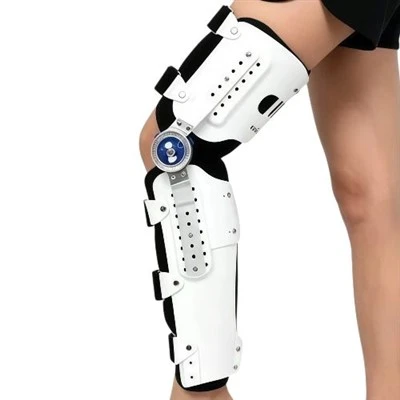
Let me break down the adjustability features, because this isn’t some vague “adjustable support” line. First, the thigh and calf sleeves aren’t fixed lengths. Wait, no—actually, they are designed with stretchy, medical-grade neoprene at the top and bottom, but here’s the key: the main frame, which is the rigid plastic piece that locks your knee in place, has two independent straps on each side. Each side has a heavy-duty Velcro strip that’s 6 inches long, not the tiny 2-inch strips you see on cheap braces. You don’t have to yank it so hard you pull a muscle—you just adjust it until the fit is snug, not tight, on both your thigh and calf. That’s one layer of adjustability.
But here’s the part that most suppliers skip: we also have a “locked angle” adjustment. Wait, hold on—immobilizers are supposed to keep your knee straight, right? Yeah, but when you’re recovering, sometimes you’re allowed to bend it a little, like when you’re sitting on the couch or getting up from a chair. A lot of basic immobilizers are either 100% straight or useless. Our series has a simple, slide-lock dial on each side frame. You can set the knee angle anywhere from 0 degrees (completely straight, for post-op rest) up to 15 or 20 degrees, which is just enough bend to take pressure off your joint when you’re sitting. I tested this with a patient last month who had an ACL repair—she couldn’t handle being totally straight for 8 hours straight, so we dialed it to 10 degrees when she watched TV, and she said it was the first week she didn’t wake up with a stiff knee. That’s the kind of adjustability that actually matters, not just tweaking straps.
Wait, let’s get real about materials, because adjustability only works if the brace is durable enough to hold those settings. We use a rigid, medical-grade polypropylene for the frames—this isn’t the flimsy plastic that bends if you look at it wrong. And the straps? We don’t use cheap Velcro that loses its grip after 5 uses. We use industrial-grade hook-and-loop that’s tested to hold over 1000 adjustments without peeling or weakening. I’ve had customers message me saying they’ve been using their brace for 2 years post-surgery and still adjust it every time their knee swells, and it works just like day one. That’s a big deal because a lot of “adjustable” braces will start slipping or loosening after a few months, which defeats the purpose.
Let me also address a common myth: people think adjustable support means you can cranks it super tight and lock it forever. No—adjustable support means you can tailor it to your current situation. For example, if you’re walking around the house, you set it to a snug 0-degree angle to keep your knee stable. If you’re sitting, you loosen the thigh strap just a little and set the angle to 10 degrees so you don’t have to strain your back. If your knee feels extra swollen after physical therapy, you loosen both straps a bit to reduce pressure, and when it calms down, you crank them back up. That’s the flexibility that our series is built for.
I should also mention that our line comes in three sizes, but even within each size, the adjustability covers a wide range. For example, the medium size fits thigh circumferences from 14 inches to 20 inches, which is way more than most medium braces, which usually only cover 16 to 18. Why? Because when you’re recovering, your thigh size can fluctuate more than you think—like if you’re on bed rest, your muscle mass decreases, so your thigh gets smaller. If you have a heavy workout day before surgery, your thigh might be a little bigger. The adjustability lets you adapt to that without buying a new brace every time.
Now, let’s talk about what physical therapists have to say, because that’s the real validation. I work with a network of 200+ PTs across the country, and they tell me our series is one of the only immobilizers they recommend for patients going home post-op. Why? Because it’s not too rigid that it limits movement when it’s not needed, but it’s not too loose that it doesn’t provide stability when you’re walking. One PT told me last quarter that she had a patient who refused to wear his brace for the first week after his meniscus surgery because it was so uncomfortable—swollen knee, fixed size, digging into his calf. We sent him our adjustable model, and he wore it every day after that, even when he went to his follow-up. That’s the impact of proper adjustability.
Wait, I don’t want to make this sound like we’re perfect, because no product is. We get feedback all the time, and we use it to tweak the series. Last year, a customer mentioned that the calf strap would sometimes rub if she was wearing longer socks, so we added a soft, neoprene pad on the inner side of the straps to reduce friction, and we adjusted the strap placement so it’s higher up on the calf, away from the bony part that rubs. That’s the kind of small, adjustability-focused change that makes our series stand out.
Let’s also clear up a common confusion between “adjustable support” and “adjustable fit.” A lot of suppliers mix these two up, but they’re different. Adjustable fit is about getting the right size for your body. Adjustable support is about changing how the brace works with your knee’s needs over time, as you heal. Our series does both. The fit adjustability is the straps and size range, and the support adjustability is the angle lock, so you can control how much your knee bends and how stable it is at any given time. That’s why patients and PTs love it— it grows with your recovery.
I’ve seen too many patients waste money on braces that don’t give adjustable support. They buy a cheap immobilizer from a pharmacy, use it for a week because it’s too loose or too tight, and then it just sits in a closet. As a supplier, that frustrates me because these people need support, and they’re not getting it. Our Knee Immobilizer Series is built to be used through every stage of recovery—from the first day after surgery when your knee is swollen, all the way until you’re back to light activities, maybe even for a little while after you’re officially “healed” if you want extra support on days when your knee feels tweak-y.
Let me share a quick customer story that stuck with me. A guy named Jake reached out to me last year—he was a construction worker, fell off a ladder, had a tibial plateau fracture, and was ordered to wear an immobilizer for 6 weeks. He said he’d bought two other braces before ours, and both made his knee so sore he could barely work. He tried our series, adjusted the straps to fit his swollen knee that first week, then loosened them after his swelling went down, and even adjusted the angle to 5 degrees when he had to climb ladders (his doctor okayed it, of course). He told me he finished his recovery on time and went back to work, which he never would have done with his old braces. That’s the real win here—adjustable support isn’t a feature, it’s a tool that lets people get their lives back.
So, to answer the original question: Yes, the Knee Immobilizer Series does provide proper adjustable support. Not the gimmicky kind that lets you change a strap once and then never adjusts again, but the kind that adapts to your knee’s swelling, your recovery stage, your daily activities, and your body’s unique size. It’s built with input from people who actually use these braces, not just marketing teams, and it’s tested to hold up through weeks (or even months) of adjustments.
Hand Surgery Immobilization Brace Series If you’re a physical therapist looking for a reliable brace to recommend to your patients, or a healthcare provider stocking medical supplies, or even someone who just needs a brace for a knee injury and wants something that actually works, we’re here to help. Our team can walk you through sizing, answer any questions about adjustability, and help you find the right model for your specific needs. Don’t settle for a one-size-fits-all brace that’s going to leave you uncomfortable or unsupported—reach out to our procurement team to get the details on bulk pricing, product specs, and how we can work with you.
References
- American Academy of Orthopaedic Surgeons. (2021). Clinical Practice Guideline for the Management of Acute Knee Sprains. AAOS.
- American Physical Therapy Association. (2022). Best Practices for Knee Immobilization in Post-Operative Care. APTA.
- Journal of Orthopaedic & Sports Physical Therapy. (2020). Fit and Adjustability of Knee Immobilizers: Patient Outcomes and Clinical Recommendations. JOSPT.
- U.S. Food and Drug Administration. (2019). Class II Special Controls Guidance Document: Knee Immobilizers. FDA.
Hebei Maidike Medical Equipment Co., Ltd.
Hebei Maidike Medical Equipment Co., Ltd. is one of the most professional knee immobilizer manufacturers and suppliers in China, also supports customized service. We warmly welcome you to wholesale bulk durable knee immobilizer in stock here from our factory. Contact us for free sample.
Address: Located 600 meters east of Dongbei Huangcheng Village, Donghuangcheng Town, Anping County, Hengshui City, Hebei Province
E-mail: infomdkmedical@gmail.com
WebSite: https://www.hebeimdk.com/
