Hey there, if you’re someone who’s been searching for a humidifier for big spaces—like a gym, a warehouse, a large office floor, or a sprawling living area in a new home—you know how frustrating it can be. Small, countertop mist generators just don’t cut it, right? They sputter out tiny amounts of mist, stop working after an hour, and leave half the room dry while the other side feels like a rainforest. As a supplier of mist generators, I’ve helped tons of people sort through this mess, so let’s break down exactly which type works best for large rooms, no jargon, no fluff. Humidification Mist Generator
First, let’s get one thing straight: “large room” isn’t just a 12×12 bedroom. We’re talking spaces 500 square feet and up—think 1,000 sq ft open-concept homes, 2,000 sq ft retail spaces, even 10,000 sq ft industrial zones. The biggest mistake people make here is grabbing a unit with a low “output” number, like 1-2 liters per hour (LPH), and expecting it to cover that big area. That’s why your mist fizzles out before it reaches the far corner. So let’s talk about the three main mist generator types out there, and which ones stand for big spaces.
Ultrasonic mist generators are super popular for small rooms—they’re cheap, quiet, and look sleek. But here’s the catch: most consumer-grade ultrasonic units max out at around 3 LPH, and their mist is tiny, water-based droplets that don’t travel far in large, open spaces. The fine mist evaporates before it hits the walls, especially if your room has good airflow (like from ceiling fans or vents). Sure, there are industrial ultrasonic models that go up to 10 LPH, but even those have issues. They can leave mineral deposits on furniture because they don’t filter out hard water minerals—if your tap water is full of calcium and magnesium, that mist turns into white dust all over your office supplies. Plus, in really large spaces (10k sq ft+), you might need multiple industrial units, which is more expensive than other options. So ultrasonic is okay for mid-sized rooms (500-1,000 sq ft) with filtered water, but not the top pick for big spaces.
Then there’s evaporative mist generators. These work by blowing air through a wet wick, which picks up moisture and releases it into the room. They’re better than basic ultrasonic because they don’t leave mineral dust—they filter water through the wick first, so hard water doesn’t create mess. But again, consumer evaporative units top out at like 4 LPH, and their mist is still not strong enough for large rooms. The industrial evaporative ones go higher, maybe 8-12 LPH, but they use a lot of energy, the wicks need constant replacing (like every 1-3 months, depending on use), and they’re big and bulky—hard to move or install in tight large spaces. They also struggle with dry climates, because the air can only hold so much moisture from the wick before it stops absorbing. So evaporative is a mid-option, but not the best for big rooms.
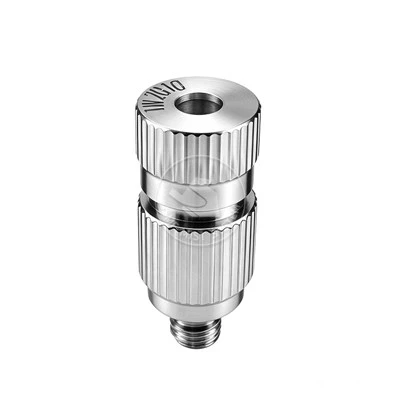
Wait, then there’s the type that we specialize in: high-pressure atomizing mist generators (sometimes called “foggers,” but not the cheap party foggers). Let me explain how these work—they push water through tiny nozzles at super high pressure (like 1000 PSI, way higher than your garden hose), which breaks the water into tiny, uniform droplets (10-20 microns, smaller than the mist from other types). That’s the key difference. Those droplets are heavy enough to travel far (up to 20 feet per nozzle) but light enough to evaporate slowly, so they spread evenly across large spaces instead of evaporating before they reach the far wall.
For large rooms, especially big open ones, this is a game-changer. Let’s test the numbers: a single high-pressure atomizing nozzle puts out about 0.5 LPH, but you can add multiple nozzles in a loop system across your entire room. For a 1,500 sq ft open-concept, you might need 4-6 nozzles; for a 10,000 sq ft warehouse, you might need 30-40, all connected to a central pump unit. The pump can push the same pressure for hours, 24/7, no sputtering, and you can adjust the mist output to match your space—no over-humidifying or under-humidifying.
Another big win for these units: they work in all climates, even super dry ones. Unlike evaporative models that stop working when the air is too dry, high-pressure atomizing just releases more droplets that hit the air, pick up moisture, and spread. They also don’t leave mineral dust, because you can add a water filtration system (we include this with all our large-room units) that removes minerals, so the mist is pure water. And they’re way more energy-efficient than industrial evaporative units—one central pump uses about as much energy as a small space heater, even when running 24/7.
Wait, but let’s be real—this isn’t the right pick for everyone. If you’re just needing a mist for a 200 sq ft kid’s room, this is overkill, and more expensive than a basic ultrasonic. But for large spaces, that extra cost is worth it. Let’s talk about the specifics you need to check when choosing, because not all high-pressure atomizing units are the same.
First, check the “coverage rating”—make sure it’s designed for spaces over 500 sq ft, not small commercial. Some cheap suppliers will label a 2 LPH unit as “large room” and it’s a lie. Second, check the nozzle size: smaller nozzles (10-15 microns) are better for even spread, larger nozzles (20-30 microns) are better for cooling, but if you’re looking for humidity, go for the smaller ones. Third, check if the unit has a built-in water tank or needs a plumbed water line. For a large warehouse, a plumbed line is better—you don’t have to refill a 50-gallon tank every day. For a large home that’s not plumbed, a 100-gallon tank works, but you’ll need to refill it every 2-3 days.
Also, there’s the noise factor. A lot of people worry that high-pressure pumps are loud, but modern ones are super quiet—we make units that run at 50 decibels, which is quieter than a normal conversation. That’s perfect for offices, gyms, or homes where you don’t want a noisy machine. The nozzles are totally silent, too—you won’t hear a thing from the mist itself, just a faint hum from the pump if it’s near you.
Let me throw in a real example to make this make sense. Last month, a customer came to me with a 2,500 sq ft dance studio in downtown Austin. He’d tried two ultrasonic units (top of the line, from a big box store) and a mid-priced evaporative unit, and none of them worked. The ultrasonic units left white dust on the ballet barres, the evaporative unit took 6 hours to raise the humidity from 30% to 45%, and the mist only reached half the room. We installed a small high-pressure system with 8 nozzles, plumbed to the studio’s water line, and set it to run during class times. In 90 minutes, the humidity jumped to 45%, it’s even across the whole room, and no dust. He told me he’s now recommending our units to other dance studio owners. That’s exactly the kind of thing we’re talking about.
Another example: a local brewery with a 12,000 sq ft storage warehouse for hops. Hops need humidity around 60% to stay fresh, or they lose their aroma and flavor. They tried 10 industrial ultrasonic units, but the warehouse was so big, the mist wouldn’t reach the back racks, and they were going through $200 worth of filters a month because of hard water. We installed a high-pressure system with 40 nozzles, a water softener, and a timer that runs 2 hours a day. Now the humidity is constant at 60% across every rack, they haven’t had to replace a filter in 6 months, and they saved 30% on energy costs compared to the ultrasonic units.
Okay, so what are the common mistakes people make when buying for large rooms? Let’s list those out, because they’re super avoidable. First, guessing the coverage. Don’t just say “my room is big, so I need a big unit”—measure your square footage, check the manufacturer’s coverage rating, and add 20% extra to be safe. Rooms with high ceilings (10 feet or more) hold less humidity, so you need more output. Open floor plans are also trickier than closed rooms, so add that 20% buffer too. Second, ignoring water quality. If your tap water is super hard, you need a filtration system—otherwise, you’re going to be cleaning dust off everything, or nozzles will clog. A good high-pressure unit will come with a filter, but if it doesn’t, add $50-100 for one. Third, going too cheap. A $200 “industrial” ultrasonic unit is not the same as a $1,500 high-pressure system designed for large rooms. The cheap units will break in 6 months, while a good high-pressure system lasts 5-10 years.
Wait, but what if you’re on a tight budget? If you can’t swing a full high-pressure system right now, is there a way to make another type work? Yeah, maybe. For a 500-1,000 sq ft room, buy two 3 LPH ultrasonic units, place them on opposite sides of the room, and use distilled water. That will help the mist spread more. For 1,000-1,500 sq ft, get one 6 LPH evaporative unit, place it near a ceiling fan, so the air blows the mist around. But note that these are workarounds, not ideal—they’ll cost more in the long run (more water, more filter replacements, more frequent repairs) than just getting the right high-pressure unit.
Now, let’s talk about maintenance, because no one wants a machine that’s a hassle. High-pressure atomizing units are actually super low-maintenance. You just need to clean the nozzles every 3-6 months, depending on water quality, and replace the filter every 6-12 months. The pump is sealed, so you don’t have to oil it or do anything fancy. Evaporative units need wick replacements every 1-3 months, ultrasonic units need the tank cleaned every week to prevent mold. So high-pressure is less work, which is a huge plus for large spaces where you might not have time to do weekly maintenance.
At the end of the day, the best mist generator for large rooms is the high-pressure atomizing type. It solves the two biggest problems with other types: mist that doesn’t spread, and mineral dust. It works in all climates, is energy-efficient, low-maintenance, and you can size it exactly for your space. Don’t waste money on small units that won’t work—get one designed for big spaces, and you’ll see the difference immediately.
If you’re still not sure, or you have a specific space (home, office, warehouse, gym) and want to pick the right size, just reach out. We help everyone from homeowners to commercial managers find the perfect system, no pressure, no confusing contracts. We’ll even give you a free consultation to measure your space and recommend the right number of nozzles and pump size. Don’t keep dealing with a dry, uneven room—let’s get you a mist generator that actually works for your large space.
Cooling Mist Generator References
- ASHRAE. (2021). Humidity Control Guidelines for Large Commercial and Industrial Spaces. American Society of Heating, Refrigerating and Air-Conditioning Engineers.
- Water Quality Association. (2020). Mineral Deposit Formation in Humidification Systems: Causes and Prevention. WQA Technical Bulletin.
- Environmental Protection Agency. (2019). Energy-Efficient Humidification Options for Large Buildings. EPA Energy Star Program Report.
Jinsheng Mist Forest-High Pressure Mist System
Jinsheng Mist Forest-High Pressure Mist System is one of the most experienced humidification mist generator manufacturers and suppliers in China, featured by quality products and low price. Please rest assured to wholesale bulk humidification mist generator in stock here and get pricelist from our factory. Customized orders are welcome.
Address: 109 Yonghong Road, Wenjiang District, Chengdu City, Sichuan Province, China
E-mail: nebufly@jinshengwusen.cn
WebSite: https://www.jswsmist.com/
