If you’ve ever walked into a pharmaceutical lab, a semiconductor fabrication cleanroom, or a beverage bottling plant, you already know how non-negotiable pure water is there. But most folks don’t stop to ask how that super-pure water stays consistent, day in and day out, without a single glitch. As someone who’s spent the last 12 years designing, building, and troubleshooting EDI (Electrodeionization) pure water systems for manufacturing facilities, that’s exactly the question I get most from clients: “What keeps this whole thing from spiraling into a mess of low-quality water and wasted resources?” The short answer is: the control system. It’s not just a fancy computer screen in a closet—this is the brain that makes the entire EDI process work, and skipping or cutting corners on it is one of the biggest mistakes I see new system owners make. EDI Pure Water System

Let’s break this down like I’d explain it to a first-time plant manager who’s just been handed the keys to a new system. First, I need to ground this in what an EDI system does, because the control system doesn’t exist in a vacuum. Reverse Osmosis (RO) pushes water through a membrane to pull out 95-99% of impurities, but EDI takes it the rest of the way, removing ionic contaminants down to 18.2 megohm-cm—the standard for ultra-pure water (UPW). EDI works by running an electric current through the water, which pulls leftover ions (like sodium, chloride, or heavy metals) out and traps them on resin beads in the EDI module. The control system has to manage three core things to make that happen: electric current flow, water pressure and flow rates, and quality checks every step of the way. Mess any of those up, and you’re either producing water that’s too impure for your application, or wasting hundreds of gallons (or kilowatts) of resources for no reason.
Let’s start with the core of the control system: the programmable logic controller (PLC) paired with a human-machine interface (HMI). You’ll hear other vendors call this a “centralized control platform,” but at its heart, it’s two parts: the PLC is the quiet, hardworking backbone, and the HMI is the part you see when you walk into the control room. The PLC is a rugged, industrial-grade computer—we build ours to operate in 30°F to 120°F, no soft office environments here—that runs 24/7, 365 days a year. It’s hardwired to every sensor, valve, and actuator on the system, so it doesn’t have the lag or downtime of regular office computers. I’ve seen a cheap PLC die after 18 months from a power surge that fried its internal circuits; that’s why we spec only PLCs made for heavy industrial use, not the consumer-grade stuff you might find in a cheap appliance.
The HMI, on the other hand, is what operators interact with. It’s a touchscreen, often mounted right next to the EDI skid, that shows real-time data: current water resistivity (that’s how we measure purity), flow rates through the EDI module, inlet and outlet pressure, power to the EDI, and even error alerts. But here’s the part most clients don’t realize: a good HMI isn’t just a dashboard. It’s built for your specific operation. If you’re a pharma plant that needs to meet FDA 21 CFR Part 11 (the regulation for electronic records), we program the HMI to log every single change to water quality, every power adjustment, and every maintenance action with a timestamp and a user ID—no one can tamper with those logs. If you’re a semiconductor fab, which needs water quality within 0.1 megohm-cm at all times, we set the HMI to send an immediate text and email alert if resistivity drops even 0.05 below the target. We even add a “one-take” log feature for maintenance: if a tech adjusts a valve or cleans a filter, they can log that in 10 seconds without navigating a 5-step menu, which saves hours of paperwork every shift.
Now, the most critical job the control system does for EDI specifically: managing the EDI’s electric current. EDI modules don’t run on the same power as your factory lights—they need a constant, precise DC current, usually between 1 and 5 amps, depending on the size of the module. Too little current, and the ions don’t move fast enough through the resin beads, leaving impurities in the water. Too much current, and you can cause electrolysis—splitting water molecules into hydrogen and oxygen gas, which damages the resin and even reduces the life of the EDI module. The control system’s power management unit (PMU) is what regulates this. It doesn’t just crank current up or down; it adjusts in real time based on two variables: water flow through the EDI module and the quality of the water coming into the EDI.
Here’s a real example from a client I worked with last year: a beverage bottler that needed ultrapure water to make their premium spring water (they use it for blending, not processing, so their resistivity target is 10 megohm-cm, not 18.2). For a few months, their old control system was sending a fixed 3 amps to the EDI, even when incoming RO water had a lower concentration of salts in the winter (since the local groundwater was cleaner in cold months). That extra current was wasting about 12% more electricity every month—add that up over a year, and it was almost $3,000 in unnecessary costs. We upgraded their control system to a PMU that automatically detects incoming water quality via a resistivity sensor before the EDI, then adjusts the DC current accordingly. Now, in winter, they’re running on 2.2 amps instead of 3, and their electricity bill for the EDI system dropped by that $3,000. That’s the kind of tangible value a proper EDI control system delivers—more than just “keeping the water pure.”
Next up: flow and pressure control. EDI modules are sensitive to how fast water flows through them. If flow is too low, the ions don’t get carried past the resin beads efficiently, leading to lower purity. If flow is too high, you’re not giving the current enough time to pull the ions out, and you’re wasting water by sending unprocessed water down the drain (wait, right—EDI systems have a reject stream, usually 10-20% of the total incoming water, that carries the removed impurities away. The control system has to balance that reject rate too; too high, and you’re wasting too much water; too low, and impurities build back up in the EDI module).
The control system uses a series of flow meters and pressure transducers to keep all of this in line. For example, a pressure transducer at the inlet of the EDI sends data to the PLC every 100 milliseconds (way faster than a human can react), and if pressure drops below a set threshold, the PLC will partially close a bypass valve to the RO system to redirect more water to the EDI, or trigger an alert if it’s a persistent problem (like a clogged pre-filter). We also program a flow-to-pressure ratio specific to each EDI module model—for our most common 5,000 GPD EDI skid, that ratio is 1.2 gallons per minute of flow per 1 psi of inlet pressure, so the PLC automatically adjusts valves to hit that sweet spot, no operator input needed. One client with a food processing plant had a problem with fluctuating city water pressure that kept making their EDI purity jump by 2 megohm-cm for a few hours every morning. We adjusted the control system’s pressure regulation algorithm to smooth out those fluctuations, and their purity became consistent 24/7.
Another big part of EDI control system is process sequencing and fail-safes. EDI systems don’t just turn on and off—they have a start-up sequence and a shut-down sequence that’s non-negotiable. Start-up: when you turn the system on, you can’t just apply current to the dry EDI module. That would damage the resin and the membrane. The control system has to first fill the EDI module with water, let it sit for 5 minutes to flush out any air pockets, then ramp up the DC current slowly over 10 minutes, not all at once. Shut-down: when the system is going to be offline for more than 4 hours, you can’t leave water sitting in the EDI module. The control system drains the reject line first, flushes the module with a small amount of clean water, and then turns off the current, to prevent bacterial growth or mineral buildup.
And the fail-safes? I’ve seen a few near-misses that could have ruined a $10,000 EDI module. Once, a tech at a pharma plant tried to override the control system’s shut-down sequence to go home early, and turned off the water flow before the current, which caused a thermal shock that cracked one of the EDI’s internal resin beds. A good control system won’t let you do that—we program a “sequence interlock” that locks out any override that would cause a safety hazard for the EDI. Other fail-safes include: if power goes out, the control system automatically switches to a backup battery (we offer 24-hour backup as standard) to hold the last set of operating parameters, so when power comes back, it doesn’t need a full restart. If water purity drops below a critical threshold (like 15 megohm-cm for a pharma application), the control system automatically diverts the bad water to a waste tank, not to the production line, which prevents product loss.
Wait, I should also talk about remote monitoring and control, because that’s changed a lot in the last 5 years. A lot of our clients have multiple facilities, or maintenance teams that are stretched thin, so they don’t want to have to be on-site 24/7 to check the system. Our control systems come with a cloud-based monitoring portal (we don’t charge extra for this, by the way) that lets you check water quality, adjust parameters, and get alerts from your phone or laptop, anywhere in the world. Last year, a semiconductor client of ours was on vacation when their EDI’s reject line started clogging, which was causing purity to drop. The portal sent them an alert at 2 a.m., and they were able to log in remotely to adjust the valve to clear the clog, avoiding a shutdown that would have cost them $100,000 an hour in lost production. That’s not a feature; that’s a necessity for modern industrial operations.
I get asked all the time if a cheaper, off-the-shelf control system from a big box industrial supplier works as well. My answer is always: maybe, but not for long. Those generic systems are programmed for one-size-fits-all, but every EDI application is different. A lab-scale EDI for a research facility has totally different needs than a 100,000 GPD EDI for a power plant. A good EDI control system is custom-tailored to your flow rate, purity requirements, regulatory needs, and even your facility’s existing automation infrastructure. We recently had a client that already had a SCADA system for their entire water treatment plant; we integrate our EDI control system with their SCADA, so they don’t have to learn a whole new interface, and all their water data is in one place for their quality audits.
Now, let’s talk about common mistakes we see with control systems that lead to problems. The first is skipping calibration schedules. Those sensors on the HMI—resistivity, flow, pressure—they need to be calibrated every 6 months, minimum. If a resistivity sensor is off by even 0.5 megohm-cm, the control system might think the water is pure when it’s not, or shut down unnecessarily for a false alert. We send our clients a quarterly calibration reminder, and many of them choose to have our technicians do it, since it’s a precision task that requires specialized equipment.
Another mistake is not updating the control system’s firmware. Just like your phone, the PLC’s firmware has updates that fix bugs, improve efficiency, and add new features. A few years back, a client of ours had an old system where the firmware had a bug that caused the reject rate to creep up 5% every month, wasting water. We sent a firmware update to their control system remotely, and fixed it in 10 minutes, no site visit needed. If you don’t update, those small bugs turn into big costs.
And finally, cutting corners on the control system to save money upfront. I’ve had clients who tried to use a $5,000 off-the-shelf control system on a $50,000 EDI skid, and within a year, they were replacing the EDI module because the current management was too rough, costing them $15,000 more than they saved on the control system. The control system isn’t an afterthought—it’s the core of your EDI system, and investing in a reliable, custom-built one will save you money on maintenance, energy, and downtime for decades.
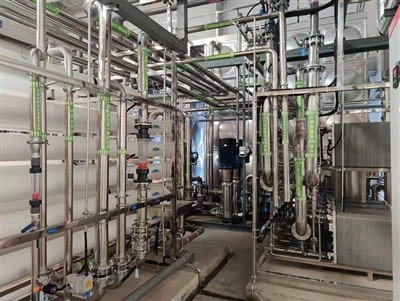
At the end of the day, an EDI pure water system is only as good as its control system. It’s not just a box that turns a machine on; it’s the system that ensures every drop of water is consistent, meets your quality standards, and doesn’t waste a single resource. Whether you’re a small biotech lab needing 100 GPD or a large manufacturing plant needing 100,000 GPD, a good control system is non-negotiable.
DI Water System If you’re looking to upgrade your existing EDI control system, or install a new EDI pure water system tailored to your needs, feel free to reach out to our team to discuss your requirements, review your current water quality goals, and get a customized solution that fits your budget. We work with clients across industries, and we’re here to help you make sure your pure water system works as hard as your business does.
References
- Miller, J. D. (2021). Electrodeionization: Principles and Industrial Applications. Water Technology Press.
- International Organization for Standardization. (2019). ISO 14644-1: Cleanrooms and Associated Controlled Environments. ISO.
- U.S. Food and Drug Administration. (2022). Guidance for Industry: Ultrapure Water Systems for Pharmaceutical Manufacturing. FDA.
- Smith, K. L. (2020). Control Systems for Industrial Water Treatment. Industrial Press.
- Semiconductor Industry Association. (2021). Requirements for Ultrapure Water in Advanced Semiconductor Manufacturing. SIA.
Shenzhen Jkon Environmental Protection Technology Co., Ltd.
As one of the most professional edi pure water system manufacturers and suppliers in China, we’re featured by quality products and good service. Please rest assured to buy customized edi pure water system made in China here from our factory. Contact us for more details.
Address: Shanghenglang Industrial park, Daloang Street, Longhua District, Shenzhen, China
E-mail: sales@jkontech.com
WebSite: https://www.jkontech.com/
